How to Write a Cover Letter in 2026 That Gets Interviews
83% of hiring managers read cover letters even when they're not required — but 68% of the ones they receive are obviously generic or AI-generated. Here's exactly how to write a cover letter in 2026 that lands in the shortlist pile, not the bin.
How to Write a Cover Letter in 2026 That Gets Interviews
Most cover letters are dead on arrival — not because cover letters don't work, but because the people writing them are doing it wrong.
Here's the uncomfortable data: <b>68% of cover letters received by hiring managers in 2026 are obviously generic or AI-generated without any editing</b> (ApplyArc, 2026). At the same time, 83% of hiring managers read them anyway — even when they're not required (Resume Genius, survey of 625 US hiring managers, 2026). And a personalized cover letter earns a 53% higher callback rate than a generic one (Jobvite, 2026).
The math is simple. Almost everyone submits a bad cover letter. The ones who don't get interviews.
The direct answer: To write a cover letter in 2026 that gets interviews, keep it to 250–400 words across four tight paragraphs: an opening hook tied to the specific role, a body paragraph with one or two quantified achievements relevant to the job description, a company fit paragraph showing you've done real research, and a confident closing call to action. Every sentence has to earn its place. A generic AI draft, unedited, does more harm than no letter at all.
This guide gives you the exact structure, paragraph-by-paragraph what to write, the mistakes that trigger immediate rejection, and how to use AI correctly to cut your writing time without sounding like a chatbot. JobFix.ai's Cover Letter Generator is built around this same framework — tied directly to your resume and the job description so each letter is tailored from the first draft.
Key Takeaways
- 83% of hiring managers read cover letters even when not required — the "nobody reads them" myth is wrong (Resume Genius, 2026)
- Personalized cover letters generate 53% higher callback rates than generic ones (Jobvite, 2026)
- 68% of cover letters received in 2026 are obviously AI-generated and unedited — the bar to stand out is low
- The ideal length is 250–400 words, one page, four paragraphs — brevity is a signal of communication skill
- 80% of recruiters reject generic AI output, but 63% accept AI-assisted letters when genuinely personalized (Cover Letter Copilot survey, 2026)
Do Cover Letters Still Matter in 2026?
Before you invest time in writing one, let's put the "cover letters are dead" narrative to rest — because it's costing candidates real opportunities.
<b>83% of hiring managers read cover letters even when the company doesn't require them</b>. When a job posting says the cover letter is "optional," 72% of hiring managers still expect one (Resume Genius, 2026). HR managers are the most likely to read them first — 33.3% start with the cover letter before they touch the resume at all (Novorésumé, 2026).
Here's the nuance that actually matters: 65% of recruiters don't read cover letters for every application — but hiring managers reviewing final shortlists read them carefully. That's the stage where your letter tips the decision. So a cover letter doesn't get you on the shortlist; it's what keeps you there and tips you into the interview slot.
The question isn't whether to write one. It's whether yours is good enough to help rather than hurt.
Key signals that still make cover letters a strong competitive tool in 2026:
- Communication proxy — Hiring managers use them to assess how you think and write. A strong one signals exactly the soft skill most job descriptions require but can't measure from a resume
- Motivation signal — A specific, researched letter tells a recruiter this is a deliberate application, not a spray-and-pray submission
- Differentiation — When resumes look similar on paper, a cover letter is often the tiebreaker. Prof. Judd Kessler of Wharton (2025) found that with AI democratizing applications, the effort of personalization has become the only differentiating signal that actually matters
📖 Harvard Business Review's coverage on AI and hiring escalation dynamics describes why generic AI output has become noise rather than signal — and why tailored effort now stands out more than it ever did.
The 2026 Cover Letter Structure That Works
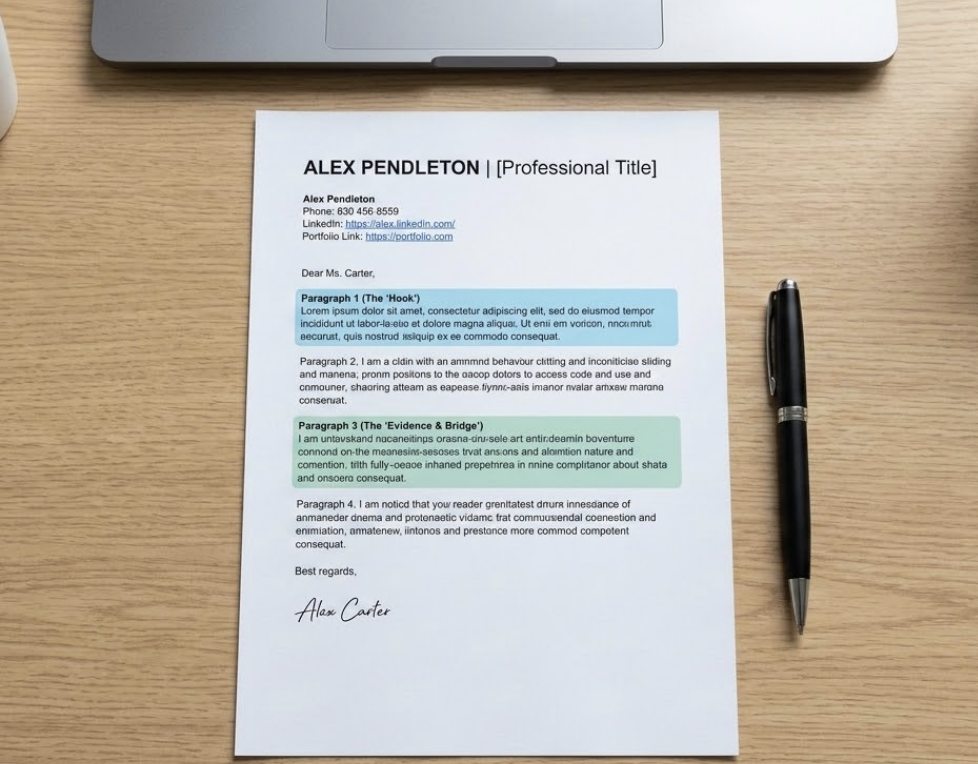
The format consensus across hiring managers and career experts in 2026 is clear: one page, 250–400 words, four paragraphs, left-aligned, 11–12pt font, 1-inch margins. Submitted as PDF unless the posting specifies otherwise.
<b>250-word cover letters have a 53% higher callback rate than letters over 500 words</b> (Jobvite, 2026). Brevity isn't laziness — it signals you can communicate under constraint, which is what every job requires.
Here's the structure:
| Paragraph | Purpose | Target Length |
|---|---|---|
| Opening Hook | Role + why you + one standout signal | 40–60 words |
| Achievement Body | 1–2 quantified wins tied to job requirements | 80–120 words |
| Company Fit | Specific research — product, mission, team, news | 60–80 words |
| Confident Close | Invite next step, brief thank you, sign-off | 40–60 words |
Now, what to actually write in each one.
How to Write Each Paragraph: With Examples
Paragraph 1 — The Opening Hook (Don't Start With "I Am Writing To")
The most common opening line in 2026 is still "I am writing to express my interest in the [role] position." It's also the fastest way to signal you're not serious.
Your opening paragraph needs to do three things in under 60 words: name the role and company, signal what makes you different, and make the hiring manager want to keep reading. The most effective openings lead with a relevant achievement or a specific reason you chose this company — not a recitation of what the job posting already says.
Generic (avoid):
"I am writing to express my interest in the Senior Marketing Manager position at Acme Corp. I have five years of experience in marketing and believe I would be a great fit."
Strong (use this structure):
"When Acme Corp launched its sustainability campaign last quarter, it reached 2.3M people in 48 hours — the kind of measurable brand storytelling I've spent five years building. I'd like to bring that same precision to the Senior Marketing Manager role."
The difference: the strong version proves attention, references something specific, and immediately demonstrates relevant capability.
💡 Pro Tip: JobFix.ai's Cover Letter Generator reads both your resume and the job description before writing the first draft — which means the opening hook is tied to your actual experience and the specific role, not a generic template. That's the difference between a 68% rejection rate and a 63% acceptance rate for AI-assisted letters.
Paragraph 2 — The Achievement Body
This is the engine of the letter. Take the two or three most relevant requirements from the job description and connect them to specific, quantified achievements from your career. Not responsibilities — results.
The formula: [Specific skill the role requires] + [What you did] + [Measurable result]
For example, for a role requiring "experience growing B2B pipeline through content":
"At my previous company, I built a content marketing program from zero, growing organic traffic from 8,000 to 62,000 monthly visitors over 18 months and contributing directly to 34% of qualified pipeline. I did it with a two-person team and a $40K annual budget — and I learned to make every piece of content accountable to a revenue number, not just a traffic metric."
This paragraph is where most people go wrong — writing job duty summaries instead of outcomes. Outcomes are what hiring managers are buying.
[Link: How to use the AI Fixer to strengthen your resume bullets — JobFix.ai Blog Post #2] → https://www.jobfix.ai/blog/resume-writing/what-is-a-job-fixer-ai-resume
Paragraph 3 — The Company Fit Paragraph
This is the paragraph that separates a tailored application from a template. It should contain at least one piece of company-specific detail that couldn't apply to any other company: a product line, a recent announcement, a mission statement you genuinely connect with, or a team's known approach.
80% of recruiters immediately reject cover letters that contain no company-specific content. If your letter reads the same with the company name swapped out, it's generic — and in 2026, generic is detectable in seconds.
For a fintech startup: "I've been following Curve's multi-card consolidation model since your Series B announcement. The problem you're solving — the cognitive load of managing five separate cards and loyalty programs — is one I've experienced and heard customers describe repeatedly. That's why this role isn't just a career move for me; it's a product category I genuinely believe in."
Spend five minutes on the company's LinkedIn, recent news, or product blog before writing this paragraph. That research compounds into a dramatically better letter.
Paragraph 4 — The Confident Close
Keep it short: two or three sentences that reinforce your fit, invite the next step, and sign off cleanly. Avoid the hedging phrases that undermine an otherwise strong letter.
Weak close: "I hope to hear from you at your earliest convenience and would be happy to discuss further if you feel I might be a suitable candidate."
Strong close: "I'd welcome the chance to talk through how my content and pipeline experience maps to your growth goals for Q3. Thank you for your time — I look forward to connecting."
The goal of the cover letter isn't to get you the job. It's to get the hiring manager to read your resume with genuine interest. A confident close signals you already expect that to happen.
Common Cover Letter Mistakes That Get Applications Rejected
81% of recruiters have discarded an applicant based solely on their cover letter (CareerBoom, 2026). Here are the patterns that cause it:
- Opening with your name or "I am writing to" — Recruiters see this hundreds of times a day and immediately classify the letter as a template
- Summarizing your resume instead of complementing it — The cover letter should add context and proof, not repeat bullet points the hiring manager just read
- Zero company-specific content — If your letter works for any employer, it works for none of them. Specific is trustworthy; generic is noise
- Exceeding one page or 400 words — Senior recruiter Jennifer Hayes puts it directly: "When I see a cover letter that extends beyond one page, I know the candidate hasn't learned to communicate efficiently"
- Using unedited AI output — 80% of recruiters reject obviously generic AI letters. Vague power verbs, uniform sentence rhythm, and zero specific numbers are the tells. AI should draft; you should edit
- Weak or hedging close — Phrases like "I hope to perhaps be considered" signal low confidence. Confidence in your close is part of the pitch
How to Use AI to Write a Cover Letter Without Getting Rejected
63% of recruiters accept AI-assisted cover letters when they're genuinely personalized (Cover Letter Copilot survey, 2026). The problem isn't the AI — it's that 68% of candidates don't edit the output.
The correct workflow:
- Input your resume + the job description — not just your experience, not just the JD. Both together. This is what produces a tailored first draft instead of a template. JobFix.ai's Cover Letter Generator does this automatically — it reads your tailored resume (from the AI Fixer pass) and the posting simultaneously.
- Let AI generate the structure and placeholder language — treat it as a first draft, not a final product
- Replace the opening with your own hook — this is the most important manual edit. Write one or two sentences in your actual voice that reference something specific
- Add real numbers to the achievement paragraph — AI avoids committing to specifics. You need to add your actual metrics: percentages, dollar figures, team sizes, timeframes
- Write the company fit paragraph yourself — AI doesn't know what you specifically admire about this company. This paragraph must come from you
- Read it aloud before submitting — if any sentence sounds like it could have been written by anyone, rewrite it
The goal: a letter that passes the "name swap test." If you can swap the company name and it still works, it's not tailored enough.
📖 ResumeLab's comprehensive cover letter statistics hub aggregates research from 200+ hiring decision-makers on what actually influences cover letter outcomes — worth reading for the data on specific phrases that trigger rejection.
Cover Letter Format Checklist for 2026
Before you submit, run through this list:
- Length: 250–400 words, one page maximum
- Font: Calibri, Arial, or Georgia, 11–12pt
- Margins: 1 inch on all sides, single or 1.15 line spacing
- File format: PDF unless the posting specifies DOCX
- Opening: Does NOT start with "I am writing to" or your name
- Achievement paragraph: Contains at least one specific number or metric
- Company fit: Contains at least one detail that couldn't apply to another employer
- Close: Invites next step, confident tone, no hedging language
- ATS compatibility: No tables, text boxes, or images in the document body
- Name swap test: Would this letter still work with a different company name? If yes, rewrite paragraph 3
[Run your resume through the ATS Checker before submitting your cover letter — JobFix.ai] → https://www.jobfix.ai
Frequently Asked Questions
Is a cover letter still necessary in 2026?
Yes — with one caveat. 83% of hiring managers read cover letters even when they aren't required, and 72% expect one even when the posting calls it optional (Resume Genius, 2026). The only situations where you can safely skip it: the application system has no upload field, the posting explicitly says not to include one, or you have an active internal referral already advocating for you. In all other cases, submitting one is always the higher-EV choice.
How long should a cover letter be in 2026?
250–400 words, one page, four paragraphs. A 2026 Jobvite survey found that 250-word cover letters have a 53% higher callback rate than letters exceeding 500 words. Brevity signals communication competence — the quality every role requires. If your letter is spilling onto a second page, you're writing for yourself, not the hiring manager.
How do I write a cover letter with AI without it sounding generic?
Use AI to generate the structure and placeholder language, then manually write the opening hook in your own voice, add your real achievement metrics to the body paragraph, and write the company fit paragraph entirely yourself. These three edits transform a generic first draft into a tailored letter. The test: read it aloud. If any sentence sounds like it came from a template, rewrite it. JobFix.ai's Cover Letter Generator uses both your resume and the job description as inputs — which produces a far more tailored starting draft than general-purpose AI tools.
Should my cover letter match my resume exactly?
No — and if it does, you've wasted the space. Your cover letter should complement your resume, not duplicate it. The resume lists your experience; the cover letter tells the story behind one or two highlights, adds context, and explains specifically why you want this role at this company. Think of them as two different documents that work together: the resume is the proof, the cover letter is the pitch.
[How to pass ATS resume screening so your resume earns the same attention as your cover letter] → https://www.jobfix.ai/blog/how-to-pass-ats-resume-screening
The One Thing That Separates Good Cover Letters From Great Ones
In a field where 68% of cover letters are obviously generic, "specific" is the entire game. Specific opening, specific achievements, specific company research — these three things, done consistently, put you in the top 10% of applicants before anyone reads a single resume bullet point.
The good news: the bar is genuinely low. Most of your competition is submitting AI output they didn't edit. You don't have to be a great writer to beat them — you just have to be a thoughtful one.
Write like you did your research. Because if you did, it shows immediately.
Ready to generate a tailored cover letter tied directly to your resume and the job posting? Try JobFix.ai's Cover Letter Generator free — no credit card needed
This post was written by the JobFix.ai editorial team. Our recommendations are independent; we don't accept paid placements.
Keep reading
Resume Letter Examples: How to Write One That Works
Learn how to write a resume letter with examples, structure, and tips that help your application sound clear, relevant, and professional.
Craft a Cover Letter That Gets Noticed: Job-Winning Tips
Learn how to write a compelling cover letter that stands out to hiring managers. Get actionable tips and examples to boost your job application success.
Land more interviews.
Build a tailored, ATS-optimized resume that gets past filters and impresses hiring managers.
Try JobFix.ai free