Mastering Your Resume: Listing Contract & Freelance Work Effectively
Contract work and freelance gigs are increasingly common, but knowing how to present them effectively on your resume can be a challenge. This guide will walk you through the best strategies to highlight your diverse experience, demonstrate your valuable skills, and ensure your resume stands out to potential employers, helping you land your dream job.
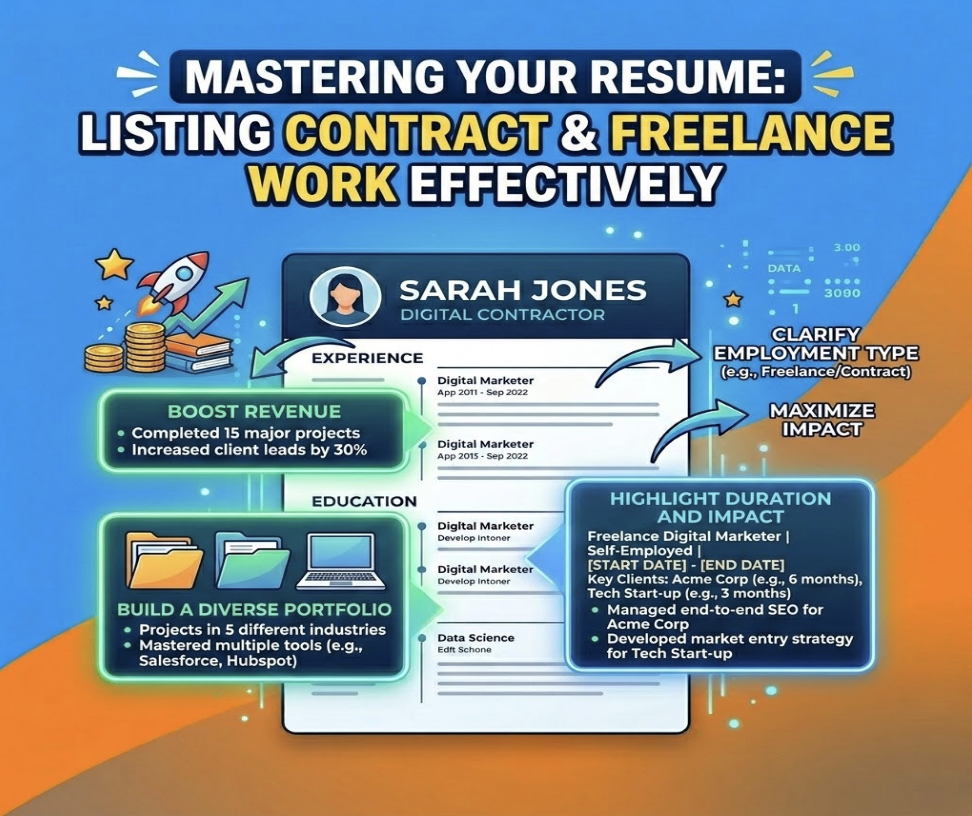
In today's dynamic job market, the gig economy is no longer a fringe movement—it's a mainstream career path. If you've been working as a contractor, consultant, or freelancer, you've developed a unique and powerful set of skills that employers desperately need. The key is knowing how to showcase this valuable experience on your resume in a way that is clear, compelling, and impressive to both hiring managers and automated systems.

Understanding the Value of Contract and Freelance Experience
First, let's reframe the narrative. Contract and freelance work is not a "gap" in your employment history; it's a testament to your initiative, adaptability, and expertise. When a hiring manager sees freelance experience on a resume, it signals a candidate who is a self-starter, can manage complex projects independently, and has a proven track record of delivering results for a variety of clients. This type of work demonstrates an entrepreneurial spirit that is highly valued in any organization.
Instead of viewing it as a series of disconnected jobs, think of your freelance career as running your own small business. You were responsible for marketing, client relations, project management, and execution—all in one. This experience shows you can wear multiple hats, meet tight deadlines, and navigate diverse business environments. By presenting it confidently, you position yourself as a versatile and results-oriented professional, not just someone "between jobs."
Choosing the Right Format: Integrated vs. Dedicated Sections
How you structure this experience on your resume is a critical first step. There are two primary methods, and the right choice depends on the consistency and relevance of your freelance work to the roles you're targeting.
The Integrated (Chronological) Approach
This is the most common and often the best approach, especially if your contract work is relevant and similar to the full-time roles you've held. You simply list your freelance or contract roles within your main "Work Experience" section in reverse-chronological order, just as you would with any traditional job. This creates a seamless, easy-to-follow career narrative for the reader.
Best for:
- Job seekers with a few long-term, relevant contract roles.
- Those whose freelance work directly aligns with their career trajectory.
- Creating a simple, traditional resume format that is very friendly to Applicant Tracking Systems (ATS).
The Dedicated Section Approach
If you've had many short-term gigs, or if your freelance work is in a different field than the one you're targeting, a dedicated section can be more effective. You can create a heading like "Freelance & Consulting Experience" or "Contract Projects" that sits either above or below your main "Work Experience" section. This prevents your timeline from looking cluttered and allows you to group related projects together.
Best for:
- Creatives (writers, designers, developers) with a wide portfolio of clients.
- Consultants who have worked with dozens of clients on short-term projects.
- Career changers whose freelance work is more relevant than their previous full-time roles.
Key Information to Include for Each Project
Regardless of the format you choose, clarity is paramount. For each contract or freelance engagement, you need to provide enough context for the hiring manager to understand the scope and impact of your work. Don't make them guess.
Here’s the essential information to include for each entry:
- Your Title: Be clear and professional. Use titles like "Marketing Consultant," "Freelance Graphic Designer," or "Contract Project Manager." If you operated under your own business name, you can list that as the employer.
- Company/Client Name: List the name of the company you contracted with. If the client is confidential, you can describe them generically, for example, "Confidential FinTech Startup" or "Major E-commerce Retailer."
- Location: City and State are sufficient.
- Dates of Engagement: Provide a clear start and end month/year (e.g., "June 2022 – Present" or "Oct 2023 – Jan 2024").
For example, if you list yourself as the employer, it might look like this:
Jane Doe Consulting | Remote Freelance UX/UI Designer | Jan 2021 – Present
Under this main entry, you can then list key clients or projects. This approach helps consolidate your experience effectively.
Crafting Impactful Bullet Points for Freelance Gigs
This is where you transform a simple list of duties into a compelling story of achievement. Vague descriptions won't cut it. Each bullet point should be a mini-case study that demonstrates your skills and the value you delivered. Use the STAR method (Situation, Task, Action, Result) as your guide and focus on quantifiable metrics.
Weak Bullet Point:
- Wrote website content for various clients.
Impactful Bullet Point:
- Developed and executed a comprehensive content strategy for a B2B SaaS client, authoring 20+ long-form articles that increased organic search traffic by 45% and generated over 200 qualified leads in Q3.
Notice the difference? The second example includes the action, the context, and a powerful, data-driven result. If you struggle to find the right words, the resume tools at JobFix AI can help you rephrase your accomplishments for maximum impact, ensuring every bullet point sells your value.

Handling Multiple Short-Term Contracts
One of the biggest challenges for freelancers is presenting numerous short-term projects without making their resume look choppy or unfocused. A hiring manager scanning your resume for 10 seconds doesn't want to see a dozen different entries for one-month gigs. The solution is to bundle them.
Create a single entry for your freelance business or your consulting title (e.g., "Marketing Consultant"). Use a comprehensive date range that covers all the gigs. Then, use your bullet points to highlight the most impressive and relevant projects. You can introduce these with the client's name or a description.
Example:
Self-Employed, Senior Content Strategist | New York, NY | 2020 – Present
- Client: TechCorp Inc.: Overhauled the company blog by creating a new SEO-driven content calendar and writing 15 pillar pages, resulting in a 200% increase in keyword rankings for the top 10 SERP positions.
- Client: HealthFirst Group: Collaborated with the marketing team to launch a new product, writing all website copy, email nurture sequences, and 5 case studies that contributed to a 25% conversion rate on the main landing page.
- Client: Startup Solutions: Advised on brand messaging and voice, developing a comprehensive style guide used across all marketing channels to ensure brand consistency during a period of rapid growth.
Keywords and ATS Optimization for Contract Roles
More than 90% of large companies use Applicant Tracking Systems (ATS) to screen resumes before a human ever sees them. These systems scan for keywords and phrases that match the job description. As a contract worker, it's crucial that your resume is packed with the right industry-specific and role-specific terms.
Start by carefully analyzing the job descriptions for the roles you want. Identify the key skills, technologies, and qualifications they mention repeatedly. Are they looking for "project management," "Agile methodologies," "content strategy," or "Salesforce"? Ensure these exact phrases appear naturally within your bullet points and skills section. To be certain your resume is optimized, run it through the JobFix AI ATS score checker. Our tool will instantly analyze your resume against a specific job description, show you your match score, and our 'missing skills AI' will even tell you which critical keywords you're missing.
When to Create a Separate 'Portfolio' or 'Projects' Section
For certain professions, a standard resume format can't fully capture the depth and quality of your work. This is especially true for designers, developers, writers, and other creative or technical professionals. In these cases, adding a "Projects" or "Portfolio" section can be a game-changer.
This section allows you to go into greater detail on 2-3 of your most significant projects. For each entry, you can include the project title, a brief description of the challenge, your specific role and contributions, the tools you used, and a link to the live project or your online portfolio. This provides tangible proof of your skills and gives the hiring manager a much clearer picture of what you can do. Using a tool like the JobFix AI dynamic resume builder, you can easily create multiple versions of your resume—one with an integrated projects section for creative roles, and a more traditional version for corporate applications.
Common Mistakes to Avoid When Listing Freelance Work
Presenting your freelance experience effectively is a huge advantage, but a few common mistakes can undermine your efforts. Be sure to avoid these pitfalls:
- Being Vague: Avoid generic descriptions like "various clients" or "freelance projects." Be as specific as confidentiality allows.
- Inconsistent Formatting: Use the same formatting for your freelance roles as you do for your full-time positions to create a clean, professional look.
- Downplaying Your Role: You weren't just "helping out." You were a consultant, a strategist, a developer. Use strong, confident titles.
- Forgetting the "Why": Don't just list what you did; explain why it mattered. Focus on the results and the value you brought to the client.
- Lumping Everything Together: Don't create a single, massive paragraph describing years of freelance work. Break it down into digestible, achievement-oriented bullet points.
Conclusion
Your contract and freelance experience is a powerful asset in your job search. By choosing the right format, crafting impactful, data-driven bullet points, and optimizing for both human readers and ATS bots, you can turn your gig work into your single greatest career advantage. Frame it with confidence, highlight your accomplishments, and show potential employers the versatile, proactive, and results-driven professional you are.
Ready to transform your resume and land your next great role? Stop guessing and start optimizing. Use the powerful suite of tools at JobFix.ai, from our AI-powered resume builder and ATS checker to our instant cover letter generator. Build a resume that truly reflects your skills and gets you noticed by top employers. Create your ATS-friendly resume today at JobFix.ai!
Keep reading
Focused Resume vs. General Resume: Which One Actually Gets Hired
Focused resume vs general resume: see the data, real examples, and why one gets interviews while the other gets rejected. Choose the right strategy for your job search.
Focused Resume Before and After: 5 Real Transformations That Got Interviews
See real focused resume transformations with before and after examples. Learn how to turn generic resumes into targeted applications that land interviews.
Focused Resume Guide: How to Create a Targeted Resume That Gets Interviews
Learn what a focused resume is, how it differs from a generic resume, and how to create one with step-by-step examples. Use our free AI resume fixer.
Ready to build yours?
Put this guide into practice. JobFix.ai builds ATS-ready resumes with AI in minutes.
Try the AI builder