Soft Skills vs Hard Skills on a Resume: Achieving the Perfect Balance
Crafting a resume that truly stands out requires a delicate balance of both soft and hard skills. Discover how to strategically integrate your interpersonal strengths with your technical competencies to impress recruiters and effectively convey your full value. Unlock the secret to a compelling application that lands interviews.
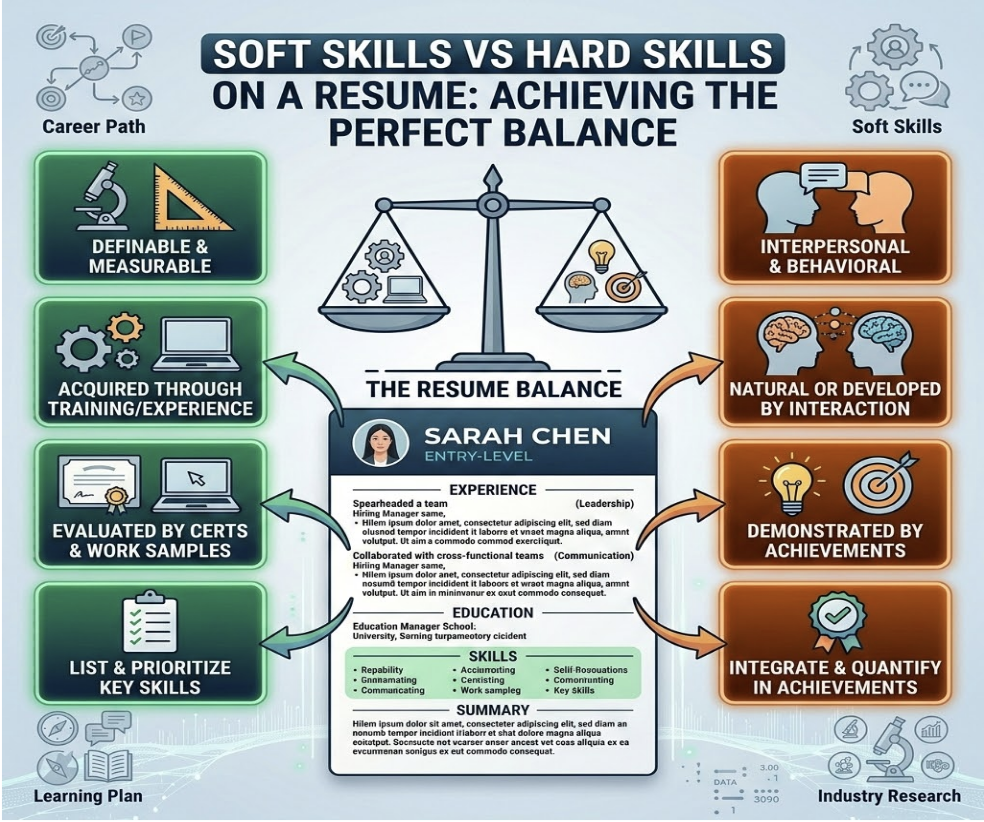
In today's competitive job market, your resume is your frontline marketing tool. But a common question we hear from job seekers is, "What's more important: my technical abilities or my people skills?" The truth is, it's not a battle of soft skills vs. hard skills; it's about creating a powerful partnership between them to present yourself as the well-rounded, high-value candidate every company wants to hire.

Understanding the Difference: Soft Skills vs. Hard Skills
Before you can balance these skills, you need to clearly understand what they are. Think of them as the "what" and the "how" of your professional capabilities. Hard skills are the "what" you can do, while soft skills are the "how" you do it.
What Are Hard Skills?
Hard skills are technical, teachable, and measurable abilities. They are often specific to a particular job or industry and can be learned through education, training, certifications, or on-the-job experience. They are the concrete proof that you have the technical knowledge to perform a role.
Common examples of hard skills include:
- Programming Languages: Python, Java, C++, SQL
- Software Proficiency: Salesforce, Adobe Creative Suite, Microsoft Excel (Advanced), QuickBooks
- Technical Skills: SEO/SEM Marketing, Data Analysis, Graphic Design, Financial Modeling
- Languages: Bilingual in Spanish, Fluent in French
- Certifications: Project Management Professional (PMP), Google Analytics IQ
What Are Soft Skills?
Soft skills, often called interpersonal or people skills, are personal attributes and character traits that dictate how you work and interact with others. They are harder to quantify but are critically important for success in any role, as they influence teamwork, leadership, and workplace culture.
Common examples of soft skills include:
- Communication: Written and Verbal Communication, Active Listening, Public Speaking
- Leadership: Mentoring, Delegation, Decision-Making, Strategic Planning
- Teamwork: Collaboration, Conflict Resolution, Empathy
- Problem-Solving: Critical Thinking, Creativity, Adaptability
- Work Ethic: Time Management, Organization, Self-Motivation
Why Both Soft and Hard Skills Matter to Employers
Imagine hiring a brilliant coder (excellent hard skills) who can't communicate with their team or take feedback (poor soft skills). That project is doomed to fail. Conversely, an incredibly charismatic and collaborative project manager (excellent soft skills) who doesn't understand the basic software their team uses (poor hard skills) will quickly lose credibility and effectiveness.
Employers know that hard skills demonstrate your ability to perform the technical aspects of the job, which often gets your resume past the initial screening. However, soft skills determine your potential for long-term success. They indicate whether you'll be a good cultural fit, a productive team member, and a future leader. In an increasingly automated world, uniquely human skills like creativity, emotional intelligence, and critical thinking are becoming more valuable than ever. A resume that showcases both proves you are not just a technician, but a complete professional.
Identifying Your Key Soft Skills and Hard Skills
Before you can feature your skills, you need to take inventory. Many job seekers know their hard skills but struggle to articulate their soft skills.
To identify your hard skills, review your past experiences. Look at job descriptions you've held, projects you've completed, and any formal training or certifications you've earned. Make a comprehensive list of every software, tool, and technical process you know.
To identify your soft skills, you need to reflect on your experiences. Instead of just thinking, "I'm a good leader," ask yourself:
- When did I successfully lead a team through a difficult project? What actions did I take? (Leadership, Problem-Solving)
- How did I handle a disagreement with a coworker or client? (Conflict Resolution, Communication)
- When did I have to learn a new process quickly to meet a deadline? (Adaptability, Time Management)
- How did I explain a complex topic to someone without a technical background? (Communication, Empathy)
A fantastic way to find the skills that matter most for your target role is by using the Missing Skills AI feature on JobFix AI. Simply upload a job description, and our tool will analyze it to show you the key skills the employer is looking for, helping you brainstorm and highlight your most relevant qualifications.
How to Feature Hard Skills Effectively on Your Resume
Hard skills are often what Applicant Tracking Systems (ATS) scan for first. You need to make them prominent, clear, and easy to find. The best practice is to create a dedicated "Skills" or "Technical Skills" section on your resume.
For maximum impact, don't just list them randomly. Group them into logical subcategories. This makes your skills section scannable for a human recruiter and is also ATS-friendly.
Example: Technical Skills Section
- Programming Languages: Python (Pandas, NumPy, Flask), JavaScript (React, Node.js), SQL
- Cloud Technologies: AWS (S3, EC2, Lambda), Docker, Kubernetes
- Data Tools: Tableau, Microsoft Power BI, Google Analytics
- Project Management Software: Jira, Asana, Trello

Strategies for Integrating Soft Skills into Your Resume
This is where most job seekers miss the mark. A list of soft skills like "Team Player" or "Good Communicator" in your skills section is meaningless without proof. The key is to show, don't just tell. You do this by weaving your soft skills directly into the fabric of your work experience.
Use your accomplishment-driven bullet points to provide context and evidence for your soft skills. Frame your achievements using the STAR method (Situation, Task, Action, Result) to demonstrate how you used a soft skill to achieve a tangible outcome.
Before (Tells):
- Responsible for managing social media accounts.
After (Shows):
- (Shows Communication & Creativity): Grew social media engagement by 45% in six months by developing and executing a content strategy that communicated brand values through creative, data-driven campaigns.
- (Shows Collaboration & Leadership): Collaborated with the sales and design teams to ensure a cohesive brand message, leading weekly brainstorming sessions that generated three new successful content pillars.
This "After" version doesn't just list tasks; it proves your value by connecting your actions (soft skills) to measurable results (hard outcomes).
Tailoring Skills to Specific Job Descriptions
A one-size-fits-all resume is a recipe for rejection. The single most important strategy for getting your resume noticed is to tailor it to the specific job you're applying for. Every job description is a cheat sheet, telling you exactly what hard and soft skills the employer values most.
Your goal is to mirror the language of the job description. If they ask for a "strategic thinker," make sure your resume demonstrates "strategic thinking." If they list "Salesforce" as a requirement, it better be in your skills section. This process is crucial for passing the ATS scan, which looks for keyword matches between your resume and the job ad.
Manually tailoring your resume for every application can be tedious. This is where tools like the dynamic resume builder from JobFix AI become invaluable. You can easily duplicate and edit your resume for each job, and our ATS score checker will instantly show you how well your resume matches the job description, suggesting keywords to add for a higher score.
Common Mistakes to Avoid When Listing Skills
Crafting the perfect skills section means avoiding common pitfalls that can get your resume sent to the "no" pile.
- The Vague Laundry List: Avoid a section overflowing with generic soft skills like "Hard-working," "Motivated," and "People person." These are clichés that add no real value. Show these traits through your experience bullet points instead.
- Exaggerating Proficiency: Be honest about your skill level. Don't list "Expert" in Python if you've only completed a beginner's tutorial. It's better to be specific, like "Python (Pandas, Matplotlib for data analysis)." You will be tested on these skills in an interview.
- Irrelevant Skills: While being a certified yoga instructor is a great personal accomplishment, it probably isn't relevant for a financial analyst position. Keep your skills section focused on qualifications directly related to the job.
- Forgetting to Quantify: Numbers speak louder than words. "Increased efficiency" is good, but "Increased team efficiency by 25% by implementing a new project management workflow in Asana" is great.
Using a professional tool like the JobFix AI resume builder can help you structure your skills and experience in a way that avoids these mistakes, ensuring your final document is polished and impactful.
The Perfect Skills Balance: Real-World Examples
Let's see how this balance looks in practice for two different roles.
Example 1: Marketing Manager
Hard Skills Section:
- Marketing Automation: HubSpot, Marketo, Mailchimp
- Analytics & SEO: Google Analytics, SEMrush, Ahrefs, Google Tag Manager
- CRM: Salesforce, Zoho
- Social Media: Sprout Social, Hootsuite, Facebook Ads Manager
Experience Bullet Points (Demonstrating Soft Skills):
- (Leadership & Strategic Planning): Led a team of four marketing specialists to develop and launch a multi-channel digital campaign that exceeded lead generation goals by 30% in Q4 2023.
- (Communication & Collaboration): Partnered with the product development team to translate complex technical features into compelling, customer-centric messaging, resulting in a 15% increase in product demo requests.
Example 2: Software Developer
Technical Skills Section:
- Languages: JavaScript (ES6+), Python, HTML5, CSS3/SASS, SQL
- Frameworks/Libraries: React, Node.js, Express, Django
- Databases: PostgreSQL, MongoDB, Redis
- Tools: Git, Docker, Jenkins, AWS (EC2, S3)
Experience Bullet Points (Demonstrating Soft Skills):
- (Problem-Solving & Adaptability): Debugged and resolved a critical production issue that was impacting user login, reducing system downtime by 90% and restoring full functionality within two hours.
- (Teamwork & Mentorship): Collaborated in an Agile/Scrum environment on a cross-functional team of six, actively participating in code reviews and mentoring two junior developers on best practices for React component architecture.
Conclusion: Your Balanced Resume Awaits
Ultimately, hard skills prove you can do the job, while soft skills prove you will thrive while doing it. A powerful resume doesn't choose between them—it masterfully integrates them to create a compelling narrative of your professional value. By featuring your technical abilities clearly and demonstrating your interpersonal strengths through concrete achievements, you present yourself as the complete package that hiring managers are desperate to find.
Don't leave your career to chance. Stop guessing what recruiters want to see and start building a resume that gets results. Use the powerful tools at JobFix AI to create a perfectly balanced, ATS-friendly resume today. From our AI-powered ATS score checker and missing skills analysis to our dynamic resume builder and AI cover letter generator, we give you everything you need to land your dream job.
Keep reading
Focused Resume vs. General Resume: Which One Actually Gets Hired
Focused resume vs general resume: see the data, real examples, and why one gets interviews while the other gets rejected. Choose the right strategy for your job search.
Focused Resume Before and After: 5 Real Transformations That Got Interviews
See real focused resume transformations with before and after examples. Learn how to turn generic resumes into targeted applications that land interviews.
Focused Resume Guide: How to Create a Targeted Resume That Gets Interviews
Learn what a focused resume is, how it differs from a generic resume, and how to create one with step-by-step examples. Use our free AI resume fixer.
Ready to build yours?
Put this guide into practice. JobFix.ai builds ATS-ready resumes with AI in minutes.
Try the AI builder